Clear Plastic Parts: CNC Machining and Vapor Polishing
Machined clear plastic comes off the machine frosted. How vapor polishing restores transparency on CNC acrylic and PC parts, and what it can't fix.
Machining a transparent part is a slightly cruel process. The part comes off the machine the right shape and the wrong look — frosted, hazed, covered in fine tool marks that scatter light in every direction. The clarity was never lost, exactly; it's buried under a microscopically rough surface. Getting it back is a finishing job, and the most effective tool for it is vapor polishing.
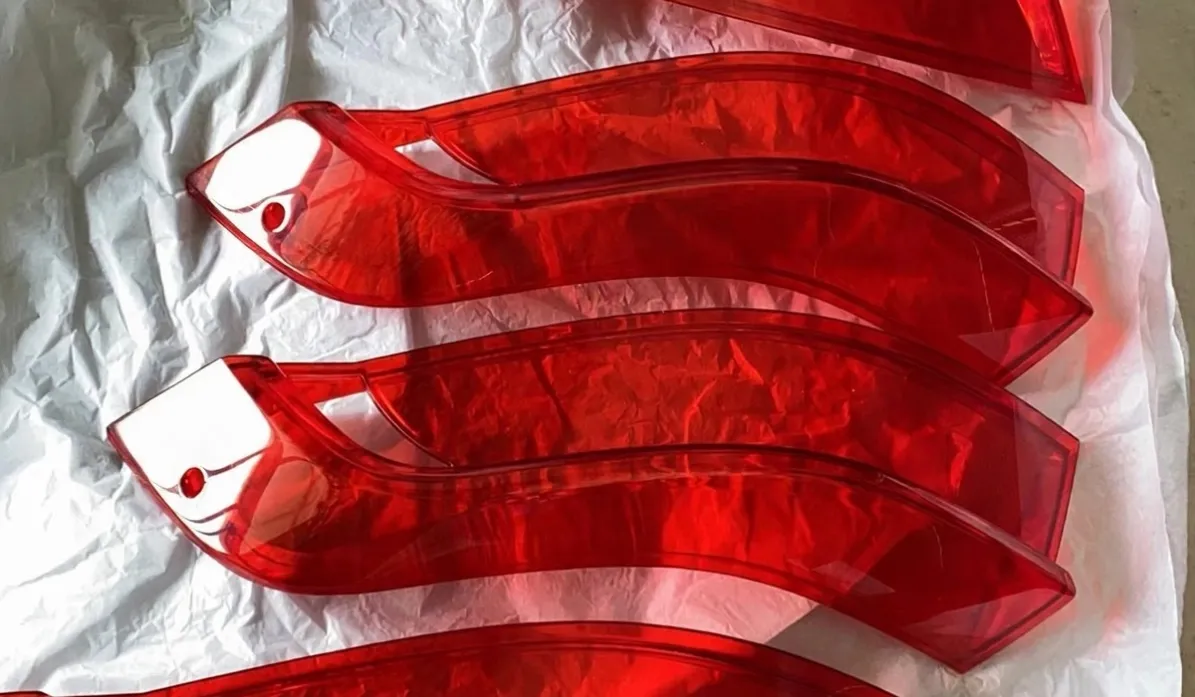
The red cover in the photo went through exactly this route: CNC machined, then vapor polished back to a clean, see-through finish.
Why Machined Clear Parts Look Frosted
Every cutting tool leaves a texture. On an opaque part, that texture is a cosmetic detail measured in Ra values. On a transparent part — acrylic (PMMA) and polycarbonate are the two common materials — the same texture turns the surface into frosted glass. Light that should pass straight through gets scattered at thousands of tiny facets.
You can sand and buff your way back to clarity, and for flat, simple shapes that works. But hand polishing is slow, uneven on curves and inside corners, and it rounds over edges and details the drawing wanted sharp. On anything with a 3D shape — a cover, a lens housing, a display window with a formed profile — there's a better way.
How Vapor Polishing Works
Vapor polishing exposes the part to a controlled solvent vapor inside a sealed chamber. The vapor softens just the very surface of the plastic — a layer measured in microns — and surface tension does the rest: the microscopic peaks and valleys of the machining texture flow together into a smooth, continuous surface. The part comes out glossy and transparent, with its shape, edges, and dimensions effectively unchanged.
A few practical points:
- It reaches everywhere the vapor reaches — curves, recesses, and internal corners that a polishing wheel can't touch get the same treatment as the easy faces.
- It's fast and repeatable. A batch of covers polishes together in one cycle, and part fifty looks like part one — something hand finishing rarely manages.
- It doesn't fix deep damage. Vapor polishing smooths machining texture; it won't erase a deep scratch, a gouge, or a crack. Parts are inspected and any heavy marks are taken out before the chamber, not after.
- Edges stay edges. Because only a micron-thin layer moves, sharp features soften only very slightly — far less than with mechanical polishing.
Acrylic responds beautifully to vapor polishing and is the usual choice when optical clarity is the priority. Polycarbonate is tougher and more impact-resistant, and it can also be vapor polished, though the window of suitable solvents and the achievable clarity differ — worth a conversation at quote stage if you're choosing between them. Tinting is another option: transparent parts can be produced in colors like the red shown here, for indicator covers, light pipes, and signal lenses where the color itself carries information.
Handling Clear Parts After Finishing
A polished clear surface shows every fingerprint and scuff, so the job isn't done when the part leaves the chamber. Finished parts are handled with gloves, kept in protective film or individual wrapping, and packed so surfaces never rub against each other in the box. It sounds fussy. It is also the difference between parts that arrive display-ready and parts that arrive pre-scratched.
One care note we pass to customers: polished acrylic and polycarbonate don't like aggressive solvents or alcohol-based cleaners, which can craze the surface. Mild soap and water and a soft cloth keep them clear.
When CNC Beats Molding for Clear Parts
Injection molding produces clear parts at scale, but it needs a polished mold — a serious investment for a part you may only need in dozens or hundreds. CNC machining plus vapor polishing covers the prototype and low-volume range with no tooling at all: send a model, get clear parts in days, change the design whenever you like. When volumes grow, the same design can move to molding — we run both, and our comparison of vacuum casting vs injection molding covers the neighboring options.
If you're developing a transparent cover, window, or light component, send the drawing or model through our CNC machining page. We'll quote within 24 hours, advise honestly on acrylic vs polycarbonate for your application, and prototypes typically ship in 3–5 days. NDA available on request.