Powder Coat, Bare Stainless, or Anodized Black: Choosing a Finish for Sheet Metal Parts
Powder coat, bare stainless or black anodizing? How to choose a sheet metal finish by environment, wear and appearance — with real parts as examples.
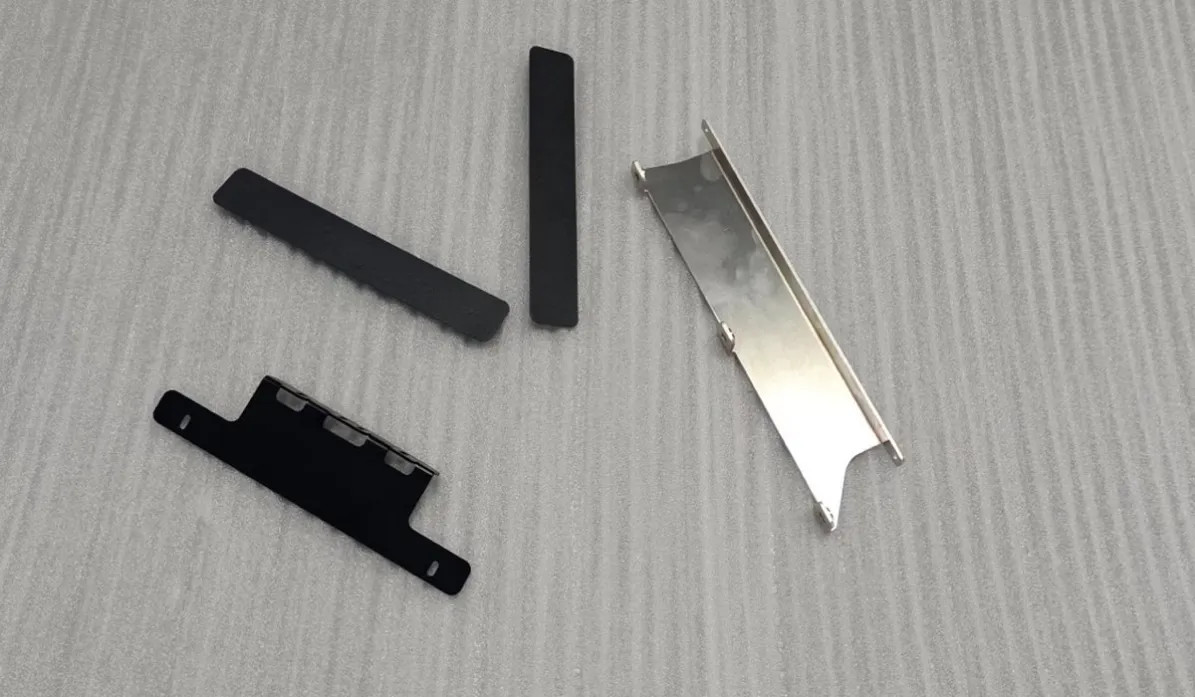
The parts in the photo are all simple sheet metal — flat strips, a small bent bracket, a formed channel. What makes them interesting is that almost none of them is the same color as the metal it was cut from, and each finish was chosen for a different reason. The black small parts are powder coated. The bright channel is stainless steel wearing no finish at all. And the long channels in the second photo are bent first, then anodized black.
Sheet metal finishing is a short menu, but picking from it well means matching the finish to the job. Here's how the three options in these photos compare.
Powder Coating: The Workhorse
Powder coating is a dry powder sprayed on electrostatically and baked into a continuous film. For brackets, covers, and small hardware like the black parts in the photo, it's the default for good reasons: it's tough, it resists corrosion and handling wear, it covers minor surface variation in the metal underneath, and it comes in almost any color, in matte, satin, or textured versions.
Two things to plan around. First, powder adds thickness — a real, measurable film on every surface. On a cover or bracket that never matters; on a part that slides into a slot or stacks against a mating face, allow for it in the design or mask the surface that can't grow. Second, sharp outside corners get the thinnest coverage, because the powder pulls away as it cures. A small edge break in the design — which we'd recommend anyway for handling — keeps corners properly coated.
Stainless Steel: The Finish Is the Material
The bright channel in the photo has no coating, and doesn't need one. Stainless steel resists corrosion through its own surface chemistry, so a stainless part can go into service bare — nothing to chip, peel, or wear through, and no coating thickness to allow for on any dimension. For parts that get cleaned often, sit in damp environments, or have sliding contact that would strip a coating off, bare stainless is often the most durable "finish" available, and the cheapest one too: the finishing step simply doesn't exist.
The honest trade-offs: you get the color the metal comes in, fingerprints and light scratches show more on a bright surface, and the material itself costs more than mild steel. If the part needs to be black for design reasons, stainless isn't the route — coating or a different base material is.
Anodized Black: Thin, Hard, and Dimensionally Honest
The long channels in the second photo were laser cut, bent, and then anodized black. Anodizing grows a hard oxide layer out of the metal surface itself rather than adding a film on top, and that changes the design math: the dimensional build-up is minimal and tightly controlled, so holes, slots, and mating faces stay the size they were cut and bent to. Precision holes and threads don't need masking for anodizing — the layer is thin enough that they work as made.
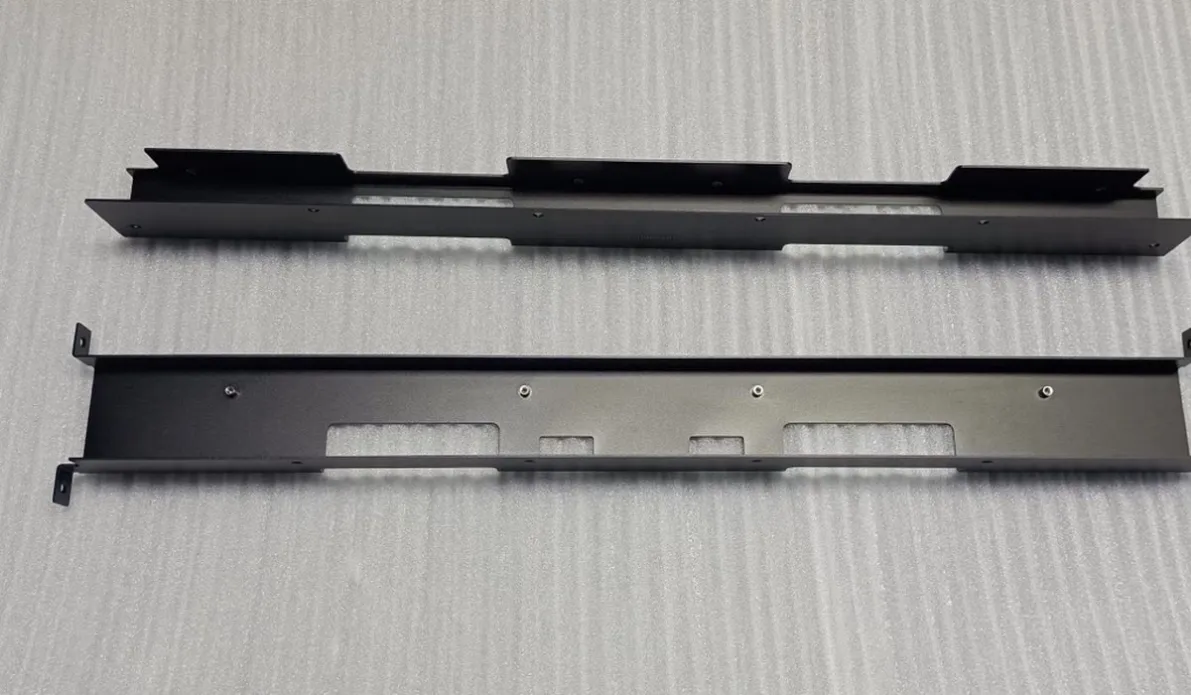
The look is different from powder coat, too: a deep, even matte black with a slight metallic quality, and a harder surface that shrugs off scuffs that would mark paint. What anodizing won't do is hide the metal underneath — surface texture and any marks in the base material show through the transparent oxide, so parts destined for anodizing get their surface preparation agreed up front. Our article on why we bead blast before anodizing covers how that preparation works on machined parts; the same thinking applies to formed ones.
So Which One?
A quick way to decide:
- The part needs a color, takes knocks, and dimensions have room → powder coat.
- The part lives wet, gets cleaned or slides against other parts, and metal color is fine → stainless, left bare.
- The part must be black, flat and precise — fits, holes and flatness can't move → anodized.
- Cost is the driver and the environment is kind → powder coat over mild steel usually beats stainless on price; ask us to quote both if you're unsure.
Whatever the finish, it's applied after cutting and bending, and parts arrive finished — the finishing is arranged alongside the fabrication, not left for you to organize. Our sheet metal fabrication and surface finishing pages list the full range.
Getting Parts Quoted
Send the drawing or flat pattern via our laser cutting page and tell us the finish you're picturing — or describe the environment the part lives in and we'll recommend one. Quotes come back within 24 hours, sheet metal tolerances are held to ±0.1 mm, and if a finish is going to fight a tolerance on your drawing, we'll flag it before production rather than after. Material certificates and inspection documents are available on request.