Machined Flanges: Types and Facings
Custom machined flanges in aluminum, stainless steel and carbon steel: blind, neck and cover flanges with flat sealing faces and true bolt patterns.
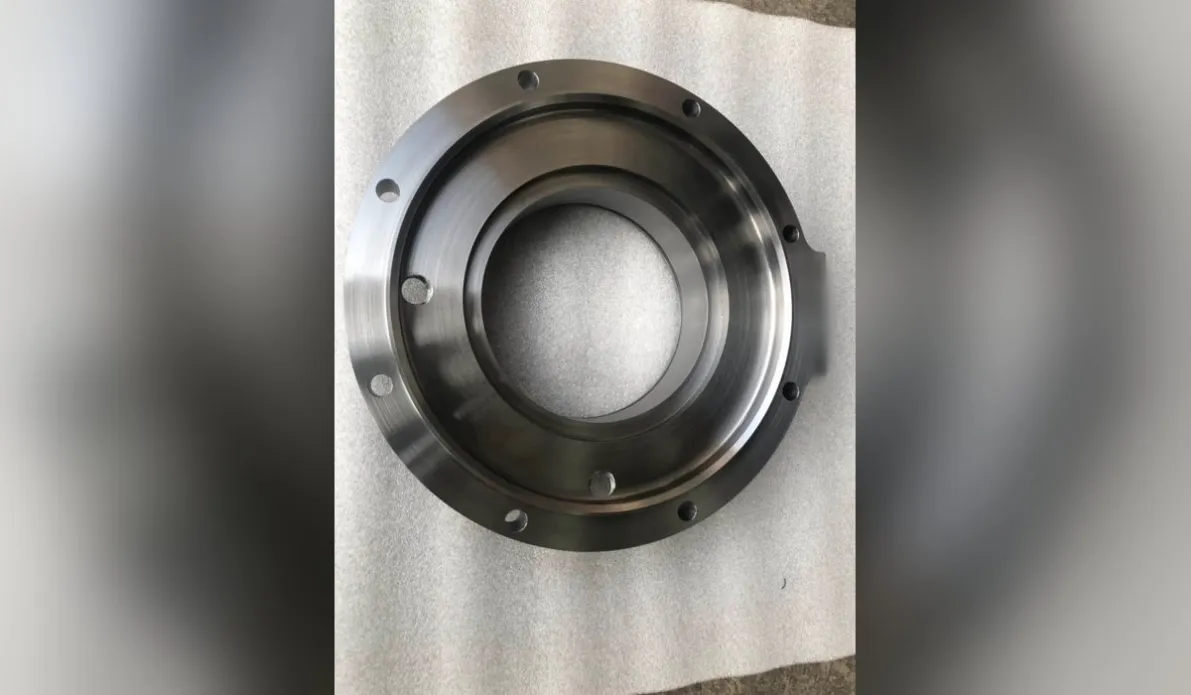
Yes — we machine custom flanges: blind flanges, neck flanges, cover flanges and one-off flange plates in aluminum, stainless steel and carbon steel. Most are turned and milled from bar or plate to your drawing, in prototype and small-batch quantities. Send the drawing and the quantity and we will quote it — inquiries are answered within 8 hours and quotes usually come back within 24 hours.
These are custom flanges machined to your drawing. If your application requires certified pressure-class pipe flanges to ASME B16.5 or EN 1092-1, with the corresponding marking and documentation, tell us at quote stage so we can confirm what applies.
The flange types we machine most
A flange is a simple part with an unforgiving job: it has to bolt up flat, seal, and put its bolt holes exactly where the mating part expects them. The types we see most often are these.
- Blind flanges — solid discs that close off a pipe, port or chamber opening. No center bore, or a small one for a sensor or drain.
- Neck and weld-neck style flanges — a raised hub that transitions into a tube or housing wall, giving the joint stiffness and a place for the weld.
- Cover and lid flanges — flat plates that close a tank, gearbox or chamber, usually with an O-ring groove or a gasket face.
- Companion and adapter flanges — rings that join two different bolt patterns or two different sizes, common when a new component meets an existing housing.
- Vacuum flanges — flanges machined to KF (ISO-KF), ISO or CF interface dimensions per drawing, with the sealing face finished for an O-ring or a metal gasket.
Because the parts are machined from solid stock rather than cast or forged, an odd size, an unusual bolt count or a non-standard thickness is not a problem — it is just a different program.

Materials
6061-T6 aluminum is the common choice for covers, adapter flanges and equipment housings: light, corrosion-resistant enough for most indoor duty, and it anodizes well when the flange is visible.
316L stainless steel is the default for wet, washdown or vacuum service. It is the same material family we use for 316 stainless steel fittings, and it takes passivation or electropolishing cleanly.
Carbon steel appears where strength and cost matter more than corrosion resistance — heavy cover flanges, machine bases and structural joints, usually finished with black oxide, zinc plating or paint.
Brass and other copper alloys show up occasionally on instrument flanges; if your drawing calls for something less common, ask and we will confirm sourcing before quoting.
What makes a flange work: facing and sealing
The outside diameter of a flange rarely matters much. The face does.
Flatness of the sealing face. A flange that rocks on its gasket leaks, however good the bolts are. Sealing faces are faced in the lathe so they sit flat against the mating part, and on vacuum and pressure faces we keep the finish fine — sealing faces are typically held around Ra 0.8 µm (32 µin).
Circular lay, no radial scratches. On turned sealing faces the tool marks run in concentric circles, which is what you want: a scratch running radially across the face is a leak path, a circular mark is not. This is the same discipline we apply on vacuum chamber components, where the sealing face gets a clean machined finish and is never bead blasted.
Raised faces and O-ring grooves. Where the drawing calls for a raised face, a tongue-and-groove, or a dovetail groove to retain an O-ring, we machine it as drawn. Groove width and depth follow your seal size — tell us the O-ring cross-section if the groove dimensions are not on the drawing, and we will flag it at the manufacturability check rather than guess.
Bolt patterns: the part everyone assumes is easy
Bolt holes look trivial until a flange arrives with the pattern rotated a few degrees or the pitch circle a fraction off, and then nothing lines up. We drill and, where needed, ream or thread the holes on the machining center from the same datum as the bore, so the pattern, the bore and the face all agree with each other.
A few things worth stating on the drawing:
- The pitch circle diameter and the number of holes, not just "equally spaced".
- Whether holes are clearance, threaded, or counterbored for socket heads.
- The angular reference — which feature hole number one is clocked from. On asymmetric patterns this one note prevents the most common flange mistake there is.
- If the flange mates with an existing part, the mating part's pattern governs. Send that drawing too, or the old part to measure.
Hole positions and bore diameters that carry seals or bearings can be held to ±0.01 mm (±0.0004") where specified; the rest of the part runs at our standard ±0.1 mm (±0.004"). Our guide to CNC tolerances and when ±0.01 mm matters explains where tight tolerance is worth paying for and where it is not.

Surface treatments
Aluminum flanges are usually anodized per MIL-PRF-8625 (formerly MIL-A-8625) Type II, clear or black, with the sealing face masked if it must stay bare. Stainless flanges are passivated or electropolished. Carbon steel flanges get black oxide, zinc plating or powder coating depending on the environment. Sealing faces and threads can be masked on any of these — just mark the masked areas on the drawing.
Inspection and what to send for a quote
Bores, sealing faces and bolt patterns are checked on every part in small batches; first article inspection with a written report, material certificates and a certificate of conformance are available on request.
For a quote, send the drawing or 3D model, the material, the finish and the quantity — and the mating part's details if the flange has to match something existing. Small-batch prototypes typically take 3–5 days, and simple parts can ship in 24–48 hours depending on complexity. We can sign an NDA before you send files. Send your drawing for a quote via our contact page.
FAQ
Can you machine a flange to match an existing housing? Yes. Send the mating drawing, or the old flange or housing itself and we can measure it and work from the measured pattern. Matching the existing bolt circle and bore is exactly the kind of one-off work machining from solid is good at.
What information do you need for the bolt pattern? Pitch circle diameter, hole count, hole type (clearance, threaded or counterbored) and an angular reference point. If any of these are missing we will ask before cutting, not after.
Can the sealing face stay uncoated while the rest is anodized or plated? Yes. Sealing faces, threads and grounding faces can be masked so they stay bare metal, and we machine with the coating build-up in mind so coated dimensions still finish in tolerance.
Do you machine vacuum flanges? Yes — KF (ISO-KF), ISO and CF interface flanges machined to your drawing, including CF knife-edge flanges and O-ring dovetail grooves. Vacuum-side faces are kept as-machined or electropolished, not blasted.
Do you accept our own material or flange blanks? Yes — for special materials you can supply your own bar, plate or blanks; tell us at quote stage and we will confirm. For standard materials we normally source the stock ourselves, and material certificates are available on request.