Skived Fin Heatsinks: Why the Fins Are Shaved, Not Machined
Skived fins are shaved from solid copper, not milled one by one. How skiving works, why it allows fins too dense to machine, and where it beats extrusion.
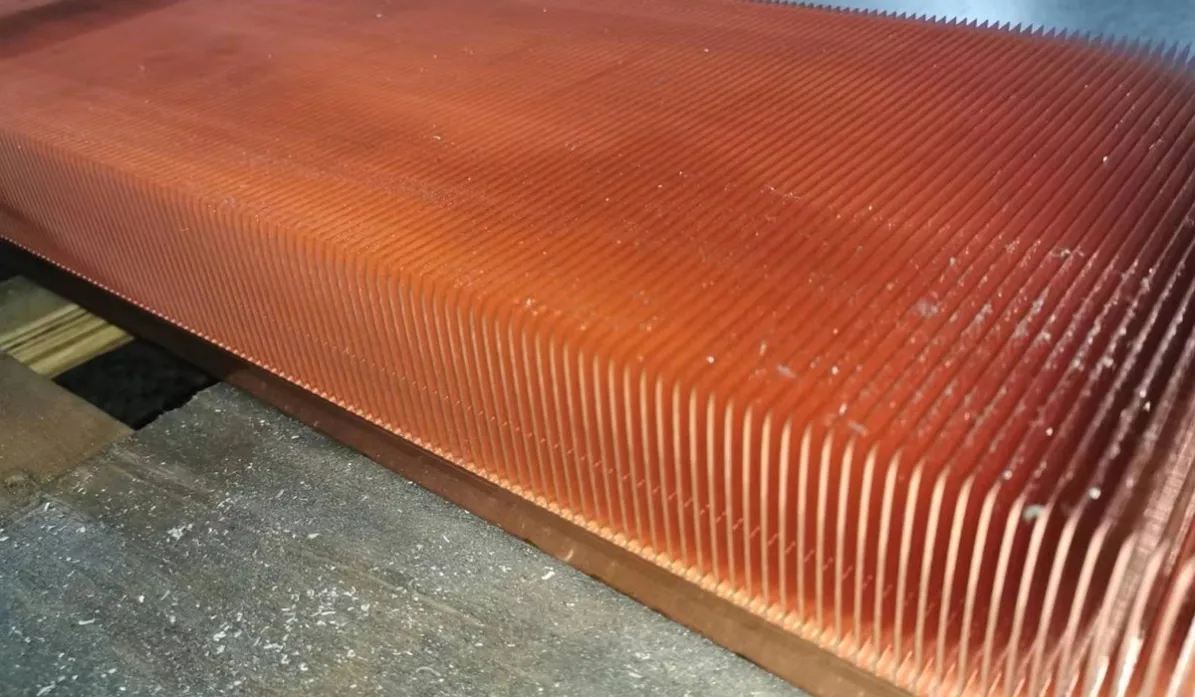
Look at the photo closely and you'll notice something odd about the fins: there are far too many of them, packed far too tightly, for a milling machine to have cut them one by one. They weren't. This copper heatsink was skived — each fin shaved up out of the solid base with a blade, one pass at a time, like a wood plane lifting a curl that never breaks off.
Skiving is an old process that keeps earning its place in modern electronics cooling. Here's why, and when it's the right choice over the alternatives.
How Skiving Works
A skiving machine uses a wide, sharp blade that slices into the top of a solid metal block at a shallow angle. The blade lifts a thin layer of metal and bends it upright — that becomes one fin, still attached to the base along its full length. The block indexes forward by one fin pitch, and the blade shaves the next one. Repeat a few hundred times and you have a dense fin field standing on a solid base.
The detail that matters thermally: the fin and the base are one piece of metal. There is no solder joint, no adhesive, no press-fit interface between fin and base. Heat flows from the base into the fin through solid copper the whole way. Bonded-fin and folded-fin heatsinks can reach similar fin densities, but every interface they add is a small thermal bottleneck and one more thing that can loosen or fail.
Why Copper, When Aluminum Is Cheaper and Lighter
Copper conducts heat roughly twice as well as aluminum — around 400 W/m·K against 200 or so for common aluminum alloys. That doesn't make copper heatsinks twice as good overall, because most of the cooling happens at the fin surface, where air does the work. What copper buys you is spreading: heat entering a small area of the base — under a power device, a laser diode, a concentrated load — spreads sideways through the copper quickly, so the whole fin field gets used instead of just the fins directly above the hot spot.
The trade-offs are real: copper costs more per kilo and weighs about three times as much as aluminum for the same volume. Skived copper makes sense when the heat is concentrated, the space is tight, and the thermal budget doesn't close in aluminum. If your heat load is spread out and the enclosure has room, an aluminum part — machined or skived — is usually the sensible answer, and we'll say so at quote stage.
Skived vs Extruded vs Machined Fins
The three common ways to get a fin field solve different problems:
- Extrusion is the cheapest route at volume, but the die sets the limits: fins can only be so thin and so close together before the die can't push metal through them. Fine for standard profiles, limiting for dense ones.
- Machining from solid gives complete design freedom — any fin direction, pockets, mounting features, steps in the base — but the cutter needs room between fins, so density tops out early, and cycle time climbs with every fin. Our article on machining a heatsink enclosure covers that negotiation in detail.
- Skiving sits between them: much thinner, denser fins than either, no extrusion die to pay for, and no interface losses. Its limits are fin height and overall size — the blade can only lift a fin so tall, and very large fields get slow.
One practical consequence: skiving suits prototypes and low-to-medium volumes well. There's no tooling to amortize, so the tenth part costs roughly what the first one did — the opposite of extrusion economics.
Details Worth Getting Right
A few things we check on every skived heatsink drawing. The base needs enough thickness left under the fins to stay flat and to mount against the heat source — the mounting face flatness matters as much as the fins do. Fin direction should follow the airflow: skived fins run in straight rows, so the part has to be oriented to the fan or the natural convection path at design stage, not after. And the fins themselves, thin as they are, need handling respect — they're sturdy in service but can bend if a heavy part is stacked on them in a carton, which is a packing detail we take care of at our end.
Copper also tarnishes. If the part will be seen, or lives in a corrosive environment, ask about plating or a protective finish when you send the drawing, rather than after the first batch arrives dull.
Getting a Skived Heatsink Quoted
Send the drawing or model through our CNC machining page and tell us the heat load and how the air moves. We'll quote within 24 hours, flag honestly if aluminum would do the same job for less money, and confirm fin pitch and thickness against what the blade can actually hold before you commit. Material certificates and inspection reports are available on request, and we're happy to sign an NDA first.