Bead Blasted and Clear Anodized: Inside a Pair of Aluminum Housings
No cutter marks, just a soft matte surface: how bead blasting and clear anodizing finish a machined aluminum housing, inside and out.
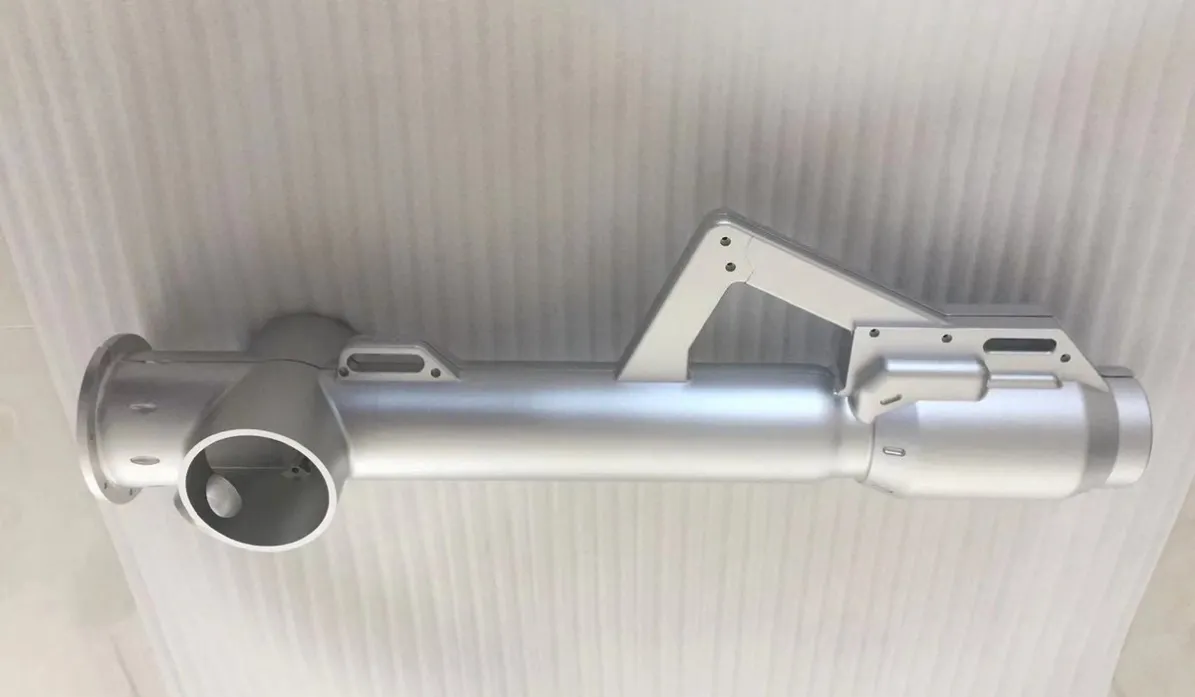
The long silver housing in the photo doesn't look machined at first glance. There are no cutter marks, no shiny facets — just a soft, even matte surface, more like a casting than something cut from solid aluminum. The second photo gives the process away: this is the same part opened up, and inside you'll find a machined bore running its full length, cross-holes, pockets, and a row of screw holes along the split line.
Parts like these — long tubular housings, tapered shells, structural brackets — are where bead blasting followed by clear anodizing earns its keep. Here's how the part is made, and why the finish is specified the way it is.
A Housing in Two Halves
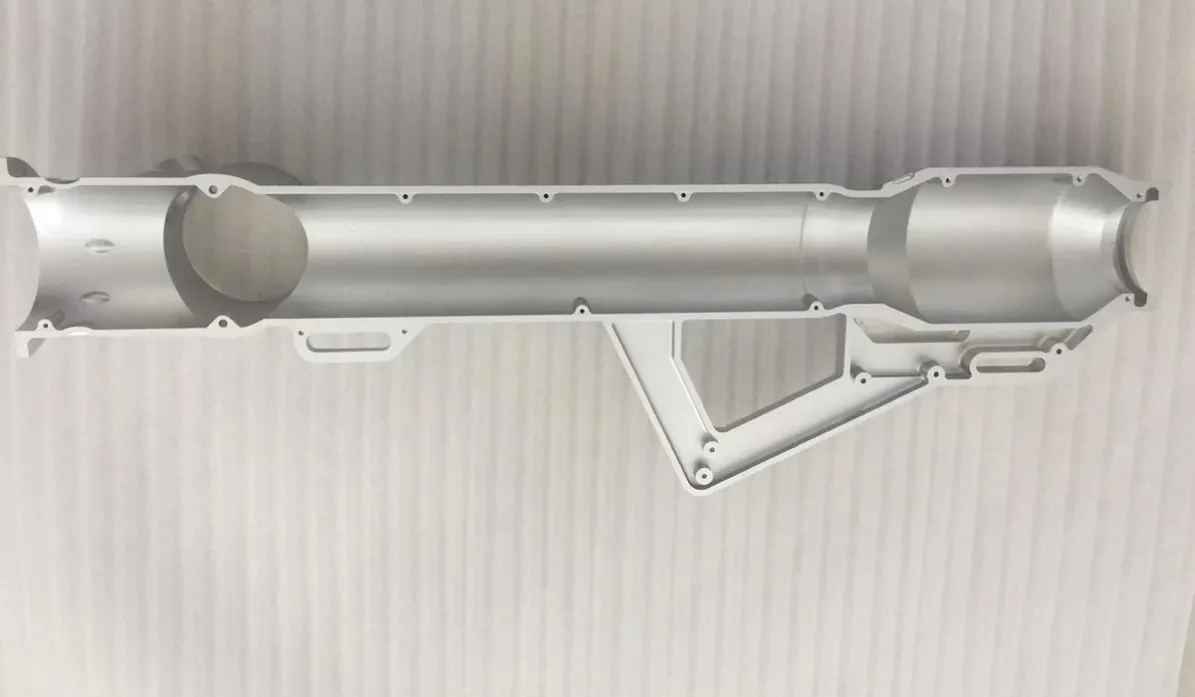
A long, closed tube is a difficult thing to machine inside. Splitting the housing along its length solves that: each half is an open channel on the machine, fully reachable by the cutter, so the internal bore, the intersecting cross-bore you can see at the left end, and the mounting pockets all get machined properly instead of approximately. The two halves then close along a flat, machined split line and are held by screws along the flanges.
That construction shows up in the details. The split faces have to be flat and matched, or the bore won't be round when the halves come together. The screw holes along the flange have to line up half to half. And the wall thickness along a long, tapered part like this is a machining discipline of its own — take too much off one side and the part moves as internal stresses rebalance. None of this is visible in the finished photo, which is rather the point.
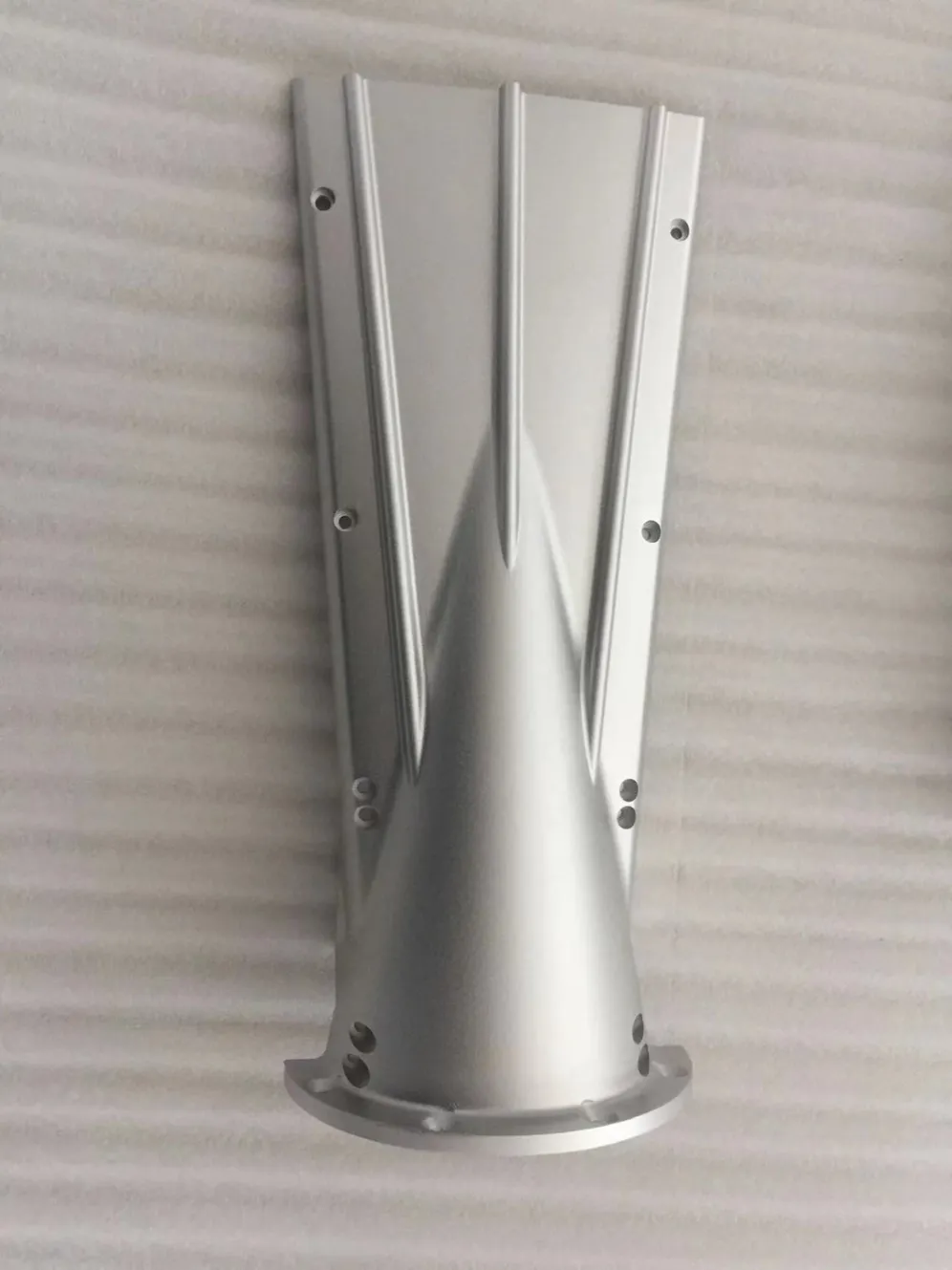
The tapered housing in the last photo is the same family of work: a shell that transitions from a flat, ribbed section into a round flange, with hole patterns on both. Shapes like this are why housings get machined from solid instead of fabricated — one piece, no welds, no seams to align.
Why Bead Blast Before Anodizing
Fresh off the machine, aluminum carries the record of its manufacture: faint tool paths, handling marks, small differences in sheen from face to face. On a large, visible housing, that patchwork look reads as cheap even when the dimensions are perfect.
Bead blasting with fine media — we use 120# as standard — erases it. The surface becomes a uniform fine matte, the same on every face, and small handling marks disappear into the texture. Our article on why we bead blast before anodizing explains the process in full. The close-up photo shows the result: an even, satin grain with no direction to it, and machined features — the counterbored holes — left crisp underneath.
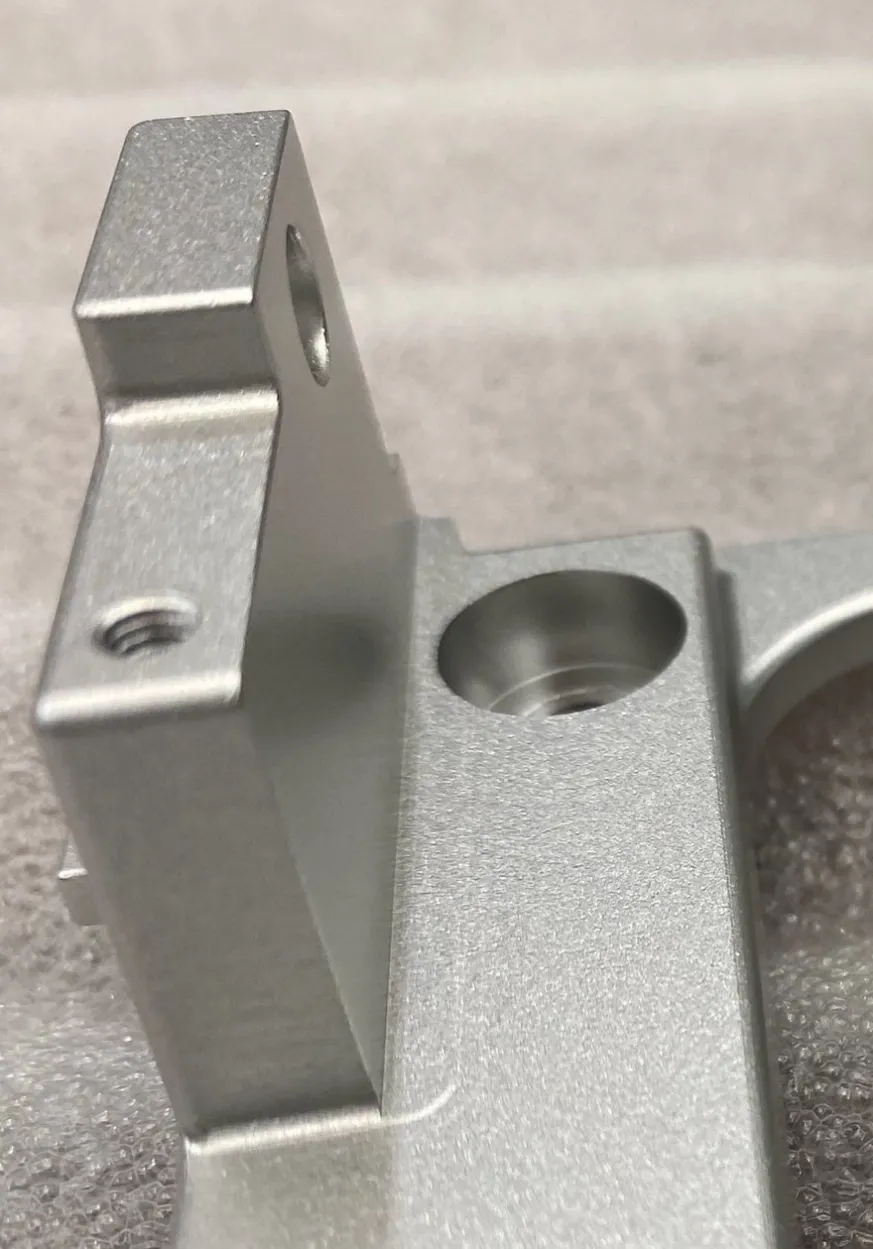
Anodizing then grows a hard oxide layer on that prepared surface. Clear (natural) anodizing adds no dye: the color you see is the aluminum itself under a transparent protective skin. It keeps the metal looking like metal, adds corrosion resistance and surface hardness, and because the layer is grown from the surface rather than sprayed onto it, it won't peel or flake at edges the way a coating can.
The Practical Questions Everyone Asks
Does the finish change the fit? Barely, and in a controlled way. The anodize layer is thin and consistent, and precision bores and threaded holes don't need masking — fits and threads work as machined. That's a real saving on a housing full of holes, and one we explain in more detail in the bead blasting article linked above.
Does the inside get finished too? Yes — the inside faces of both halves are blasted and anodized along with the outside, as the opened-up photo shows. The bore surface you see there has the same matte finish as the exterior.
What does it feel like? Smooth and dry, with a very fine grain — closer to satin than to sandpaper. It doesn't show fingerprints the way a polished or as-machined surface does, which is one reason it suits housings that get handled.
Which specification covers this? Clear anodizing of this kind is typically ordered under MIL-A-8625 Type II; our guide to anodizing specs explains the types and classes if your drawing needs the right callout.
Getting a Housing Quoted
Housings are exactly the parts where a short conversation at quote stage pays off — split lines, wall thickness, and finish callouts are all cheaper to settle before metal is cut. Send your model through our CNC machining page. Quotes come back within 24 hours, machined prototypes typically ship in 3–5 days, and FAI reports, material certificates, and a certificate of conformance are available on request. NDA on request.